
Trace Lyon County Former Owners by Source
Work from the newest reliable instrument backward through Lyon County property records. The Register of Deeds records-search page sends today's researchers to Fidlar Laredo for Lyon County and to Tapestry for a wider Fidlar search. Older transfers may live in deed books instead. For those, the Kansas Historical Society Lyon County collection is the place to turn. The county publishes no confirmed start date for its current online index.
| Source | Years It Covers | Where Held | What It Shows |
|---|---|---|---|
| Laredo or Tapestry index | Current coverage not verified | Register of Deeds route | Party, instrument, date, and reference leads |
| Recorded deed books and microfilm | Historic county series | Register of Deeds and KSHS | Earlier grantor-to-grantee transfers |
| Subdivision plats | Varies by addition | County plat index | Lot, block, rights-of-way, and vacations |
| Ownership atlases | 1878, 1901, 1918 | Kansas Historical Society | Dated rural owner and section clues |
Begin with the current legal description and the newest deed. Treat an atlas only as a dated lead. Prove every transfer with the recorded instrument itself. An atlas name may point to the right section, but it never establishes title.
Build a Lyon County Deed-Chain Timeline
Make one row for every verified transfer in your timeline. That habit keeps a same-name hit, a mortgage, a release, or an unrelated parcel from masquerading as a conveyance.
| Transfer date | Grantor to grantee | Instrument | Reference |
|---|---|---|---|
| Newest first | Seller to buyer | Warranty, quitclaim, fiduciary, or other deed | Instrument number or book/page |
| Prior transfer | Earlier seller to later seller | Recorded conveyance | Matched legal description |
| Historic link | Earlier named parties | Deed-book entry | Volume/page and archive citation |
Put the legal description beside every row. A surname that repeats is helpful, but the land description is the stronger link between records.
The Pre-2000 Image Notice Is Only a Clue
Legacy Lyon County instructions once said documents before 2000 could not be viewed online. The county now points users to Laredo and Tapestry. No official current page confirms that the old image cutoff still defines the present index. Treat 2000 as a warning to ask questions. Do not treat it as a firm coverage boundary for Lyon County property records. If an image will not open, save its party names, document type, date, and reference. Call or visit the Lyon County Register of Deeds. The office sits at the courthouse, 430 Commercial Street in Emporia. Ask whether the instrument sits at a public terminal. It may instead sit in a deed book or in copy-request form.
Note: Index data is a finding aid; read the recorded image and verify its legal description before adding a person to the chain.
Anchor Past Owners to Lyon County Land
Street addresses are modern conveniences and can change over time. Lyon County records may instead identify land by subdivision, lot and block. Others use section, township, and range. Copy that wording exactly from the latest deed. Compare it at every backward step of your property search.
- Grantor
- The party conveying an interest.
- Grantee
- The party receiving the recorded interest.
- Chain of title
- The ordered sequence of instruments affecting the same land.
- Reverse index
- An index organized to help locate a party in the opposite deed role.
- Quitclaim and warranty deed
- Different conveyance forms; neither should be summarized without reading the instrument.
A parcel number also serves as a good working key in modern systems. It cannot replace the deed's legal description, though, once a parcel was split, combined, replatted, or renumbered.
Walk the Lyon County Deed Chain Backward
Start with the newest recorded conveyance for the land. The buyer becomes the present grantee. The seller is the next former owner to research in the deed records.
- Find the current owner's acquisition deed and verify the parcel or legal description.
- Read the grantor name, deed date, recording date, and any prior-instrument reference.
- Search that grantor as an earlier grantee, then match the same land.
- Repeat until the online evidence ends, then continue through deed books, microfilm, plats, and archive aids.
- Party roles
- A person may appear as grantee when acquiring and later as grantor when conveying.
- Recording date
- The date the office accepted the instrument, which may differ from its signed date.
- Prior reference
- A book/page or instrument citation that can bridge one transfer to another.
Lyon County Plats Explain Changes in the Chain
The official subdivision-plat index can explain a change. The same ground may show up under a new addition or phase name. Plats may preserve lots, blocks, streets, utility areas, easements, and vacation references. Americus is a strong example. Its town plat carries section and range geometry plus recorded vacation and easement clues. Search each exact phase or addition name in Lyon County property records. Crestview Lakes phases and Eastwood additions in Emporia are good cases. Dropping a suffix can join two different recorded plats. Follow a plat's volume/page or ordinance reference back to the Register of Deeds.
Ownership Atlases Bridge Rural Lyon County Years
The Kansas Historical Society ownership-map guide identifies Lyon County atlases for 1878, 1901, and 1918. Each atlas is a snapshot. Use it to pair a surname with a section before opening older deed books. Triangulate the atlas name with section, township, and range. Then check federal tract or patent material. County deeds, census entries, cemetery records, and newspaper legal notices add more. The KSHS Lyon County microfilm collection spans 1865 through 1980. It reaches beyond land instruments, which helps separate families sharing a surname.
Open the Lyon County Archive Finding Aid
The Kansas Historical Society Lyon County finding aid shows the archival route when former owners vanish from the current online trail.
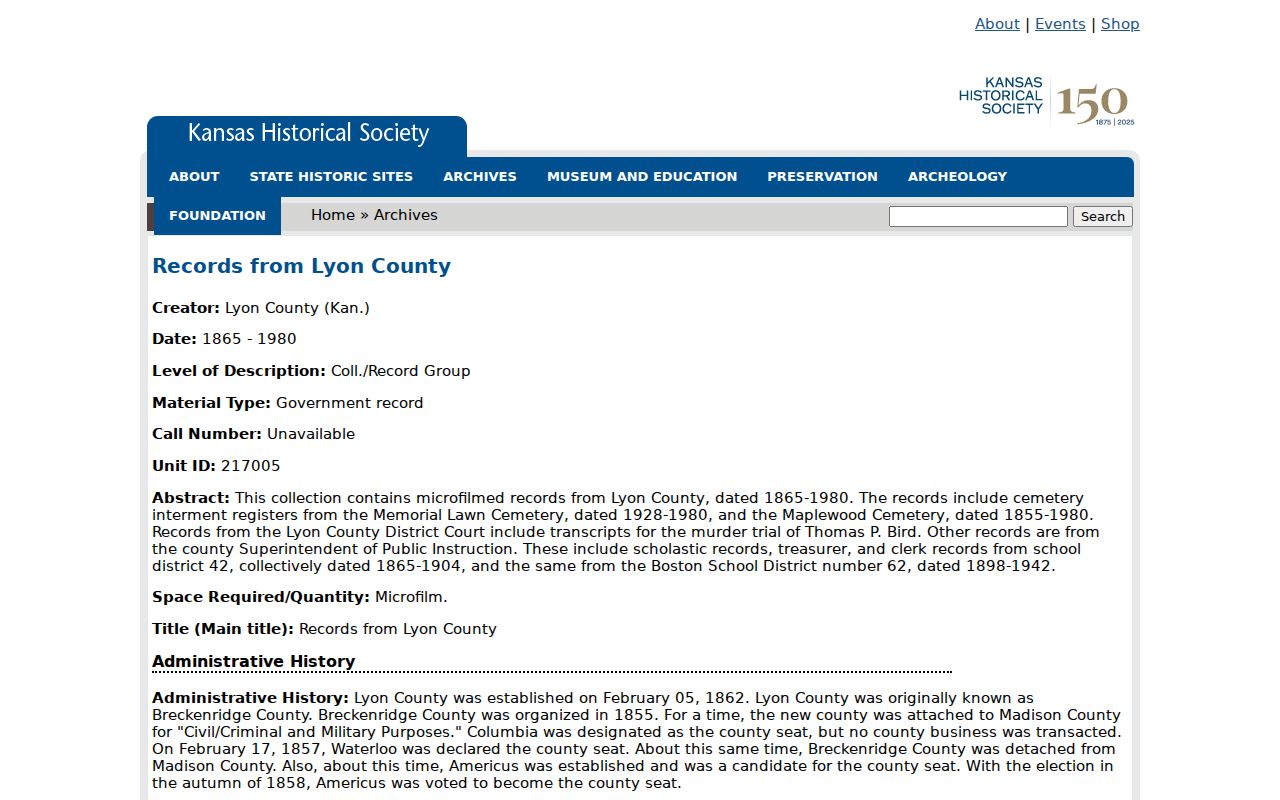
The collection view helps a researcher spot microfilm and related historical series before requesting the exact reel or volume.
Probate Records Can Bridge a Lyon County Owner's Death
A clean sale-to-sale sequence can stop dead when property passed through an estate. Search the Kansas District Court public-access system for a Lyon County probate case. Then look for a fiduciary deed, court order, or distribution. Or find a later conveyance in the land records. Death certificates are not open browsing records in Kansas. Certified access is limited under K.S.A. 65-2422d. The practical ownership trail usually depends on the probate docket and the recorded instrument. Preserve names, case numbers, dates, and the land description. Never assume an heir became owner of record. Wait until a deed or court order says so.
Keep a Former-Owner Chain Worksheet
A written worksheet makes gaps visible. For each step, capture both parties, their deed roles, signed and recorded dates, instrument type, instrument number or book/page, and the legal description. Note any related plat, release, probate case, or assignment.
- Search spelling variants and initials.
- Separate deeds from mortgages, releases, and assignments.
- Compare the legal description at every step.
- Mark an index-only hit as unverified until the image is read.
- Cite the archive collection when evidence comes from microfilm.
That discipline lets another researcher repeat the ownership history without relying on an unexplained list of names.
How Far Back Lyon County Ownership Records Go
Lyon County was organized in 1855. No single starting date covers every deed series. No courthouse disaster erased the chain of title, either. The real starting point is the earliest instrument recorded for your specific tract. Before the county existed, federal land evidence may survive. The KSHS land-record guide points to those materials, which you can then join to later county transfers.
Courthouse geography also matters when you track old deed books. KSHS places an 1866 stone courthouse at Third, Santa Fe, and Commercial. A later courthouse followed around 1902 at Fourth and Commercial. Today the county records offices sit at 430 Commercial Street. Call ahead before visiting, because not every older book is online.
Use the chain with care. Former-owner research supports house history, estate work, and property diligence. An index result is not a title opinion, and no record should be used to target or harass a living person.